

How to Review Your Auto Insurance Deductibles Step by Step
An Ontario auto insurance deductible review process
Short answer: Review auto insurance deductibles one coverage at a time. Start with the current certificate and policy, record every deductible beside the coverage it applies to, ask for comparable scenarios that hold other coverage and rating information constant, test whether you could pay the amount after a loss, check vehicle and finance or lease constraints, then confirm the selected terms and effective date in writing. Do not choose from the premium difference alone.
An Ontario auto policy can contain more than one deductible. Collision or upset, comprehensive, specified perils, all perils and direct compensation-property damage can be treated differently. A statement such as “my deductible is $X” is incomplete unless it names the coverage, vehicle, policy term and claim circumstances.
This how-to guide is a workflow, not a recommendation for a high or low deductible. Only the insurer can confirm how the policy responds to a specific claim. Chase Insurance Brokers’ current site provides auto insurance and quote routes, but no page establishes the right deductible, premium or coverage for an individual reader.

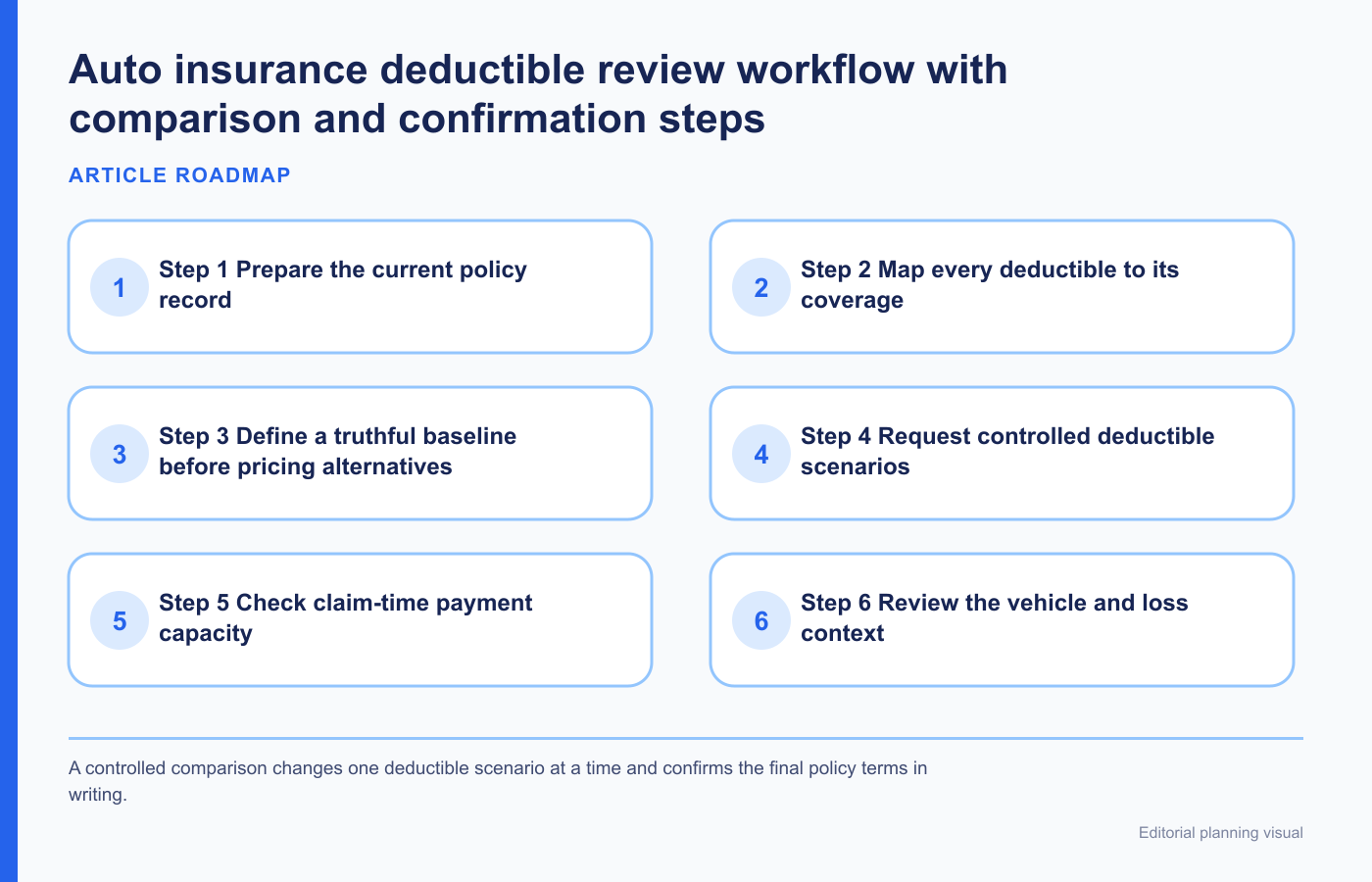
Step 1 Prepare the current policy record
Collect the Certificate of Automobile Insurance, policy wording, endorsements, renewal offer and the latest change documents. Confirm the insured vehicle, named insured, drivers, address, vehicle use, annual distance, coverages, limits, deductibles and term dates. Do not use last year’s certificate if the policy changed.
FSRA publishes the current Ontario automobile policy and consumer forms. Your own issued contract controls your coverage, not a generic form or blog summary. Ask the insurer, agent or broker for missing documents.
Mark anything that has changed: commute, delivery or rideshare use, drivers, residence, vehicle ownership, annual distance, modifications, finance or lease status and other material facts. FSRA’s consumer guidance says policyholders are responsible for giving accurate information and reporting relevant changes. A deductible comparison built on stale information is not a reliable comparison.
Step 2 Map every deductible to its coverage
Create one row per coverage rather than one row per policy. Copy the exact coverage name and deductible from the certificate. If a coverage is absent, write “not shown” rather than assuming a zero deductible or included protection. Ask what the wording means before changing anything.
| Coverage row | Current deductible | What to confirm |
|---|---|---|
| Collision or upset | Copy from certificate | Covered events, exclusions and claim application |
| Comprehensive | Copy from certificate | Which non-collision losses fall within this coverage |
| Specified perils | Copy if present | Named perils and relationship to other physical-damage options |
| All perils | Copy if present | How it differs from separate collision and comprehensive |
| Direct compensation-property damage | Copy if present | When the coverage and deductible can apply |
FSRA’s rate-factor guidance says insurers may offer separate deductibles for these coverages. It also says deductible choice is one of several rate factors. That is why a policy-wide number or a generic “higher saves more” shortcut is inadequate.
Step 3 Define a truthful baseline before pricing alternatives
Ask for a baseline that reflects the current vehicle, drivers, use, address, annual distance, coverages, limits, endorsements, discounts and term. Record whether it is a renewal offer, mid-term change or new-business quote. Those are not interchangeable.
Check that the baseline includes the coverage you intend to compare. A lower premium paired with reduced coverage or a removed endorsement is not a deductible-only comparison. Likewise, a different insurer may apply different underwriting, discounts and service terms, so label the scenario rather than treating it as a controlled one-variable test.
FSRA advises consumers to compare coverage, deductibles, limits, optional coverage, service and price. Keep a copy of each scenario and the assumptions used to produce it.
Step 4 Request controlled deductible scenarios
Ask the insurer or broker to show the options actually available for the policy and vehicle. For each scenario, request the same effective date and hold all other selected coverage and rating information constant where possible. The output should identify the deductible changed and the resulting total premium, not merely a percentage claim.
- Start with the current or proposed baseline.
- Change one coverage deductible to an available alternative.
- Confirm no other coverage, limit or endorsement changed.
- Record the premium for the full policy term and payment plan effects.
- Repeat for another deductible only after restoring a clear baseline.
- Label insurer, term, quote date and expiry.
A premium difference is quote evidence for that scenario and date. It is not a permanent saving, guarantee or reason to change. Insurer rates and personal circumstances can change.
Step 5 Check claim-time payment capacity
For each deductible, ask a practical question: if a covered loss happened soon after another household expense, could you pay the required amount without missing essential obligations or using costly debt? Do not count on future income, a claim payment or an emergency fund that is already committed elsewhere.
Keep premium and deductible in different columns. The premium is the cost of the policy; the deductible is your portion of certain covered losses when applicable. A lower premium does not fund the higher claim-time amount unless you deliberately preserve the difference—and even then, claim frequency and coverage application are uncertain.
FSRA’s consumer savings page explains that raising a deductible means contributing more toward a loss and can mean a lower premium. It also recommends discussing the options with an agent or broker. The appropriate balance is individual and must be reviewed with the actual policy terms.
Step 6 Review the vehicle and loss context
Record the vehicle’s age, condition, current realistic value range, finance or lease status, daily importance, replacement options and security or parking context. Do not use the purchase price as the current value and do not assume what an insurer would pay after a loss.
Compare the deductible to the kinds of covered loss for that row, not to the vehicle in the abstract. Comprehensive and collision can address different events. A deductible close to a small potential claim may affect whether making that claim is practical, but the insurer determines coverage and settlement under the policy. Do not decide to avoid reporting an accident based on a blog calculation.
If removing a physical-damage coverage is part of the conversation, treat that as a separate coverage decision, not a deductible change. Ask what protection would be lost and how a finance or lease agreement affects the option.
Step 7 Check finance, lease and household constraints
Read the finance or lease agreement for required physical-damage coverage and maximum deductibles, then confirm the interpretation with the lender or lessor and insurance representative. Do not assume every contract uses the same limit. A change that satisfies the insurer may still breach another agreement.
Consider who drives the vehicle, who would pay the deductible, whether another vehicle is available, and whether loss of use or transportation replacement coverage exists. These details do not dictate a deductible, but they reveal the operational effect of a claim.
For a vehicle used in business, delivery or rideshare activity, disclose the use accurately and ask about the correct policy. A personal-policy deductible comparison cannot repair a mismatch in declared use or coverage.
Step 8 Ask coverage-specific questions
Use the same questions for every scenario so the answers are comparable:
- Which exact coverage does this deductible apply to?
- Is the deductible per occurrence or applied another way under this wording?
- Which deductible would apply in the example I described, and what facts could change that answer?
- Did any coverage, limit, endorsement or discount change in this scenario?
- Is this option available for this vehicle and insurer?
- What is the full-term premium difference and are there payment-plan effects?
- Does the change require underwriting approval or new information?
- When would the change become effective?
- What written document will confirm it?
Do not ask a representative to guarantee a future claim outcome. Request an explanation tied to the current policy, then read the written terms. For a claim already in progress, direct coverage and deductible questions to the insurer or assigned adjuster.
Step 9 Confirm the selected terms before relying on them
A quote does not necessarily change an active policy. Ask whether you are reviewing an illustration, application, renewal offer, binder or confirmed policy change. Obtain the effective date and updated certificate or endorsement through an official channel. Review the vehicle, coverage and deductible rows again.
Do not cancel an existing policy merely because another quote looks better. Confirm the new coverage is accepted and effective, understand cancellation terms and avoid a gap. Never stop a scheduled payment as a substitute for a documented cancellation process.
Save the representative’s name, date, reference number and documents. If you use a broker, RIBO’s consumer page links to current broker and brokerage registries. Verify official registration there rather than relying on a logo or website statement.
Step 10 Keep a claim-ready record
Store the current certificate, policy, endorsements, insurer claim contact and vehicle information somewhere accessible after an accident. A copy that exists only inside a damaged phone or locked vehicle may not help. Know how to reach the insurer, agent or broker through a verified number.
FSRA’s claims guidance says to report an accident as required by the policy and describes information to gather. The adjuster determines how much the insurer covers and guides the process. Do not promise payment to another party, admit policy coverage or decide the applicable deductible from an online summary.
After a claim, compare the adjuster’s deductible explanation with the certificate and policy section. Ask questions promptly if they differ. Use the insurer’s complaint process and regulator information when appropriate.
Common deductible review mistakes to avoid
- Treating the policy as having one deductible. Map each coverage separately.
- Comparing premium alone. Check coverage, limits, endorsements and service.
- Changing several variables at once. You lose the deductible-specific effect.
- Choosing an amount you could not pay after a loss. Test payment capacity before changing.
- Ignoring a finance or lease agreement. Confirm external requirements.
- Assuming a quote changed the policy. Obtain written effective-date confirmation.
- Predicting claim response from a hypothetical. The issued policy and claim facts control.
- Relying on unverified licensing or savings claims. Check official registries and scenario-specific documents.
Frequently asked questions
Does increasing an auto insurance deductible always lower the premium?
FSRA says it can mean a lower premium, but available options and the actual difference depend on the insurer, coverage, vehicle and policy. Request a controlled quote rather than assuming an amount.
Where can I find my deductibles?
Start with the current Certificate of Automobile Insurance and endorsements. Ask the insurer, agent or broker to explain each coverage row and provide missing documents.
Does the deductible apply to every auto claim?
No universal answer should be inferred. Deductibles can differ by coverage, and the insurer or adjuster applies the issued policy to the claim facts. Ask which section and amount they are using.
Can I change a deductible mid-term?
An insurer may offer a change, subject to its rules and underwriting. Ask whether it is available, what else changes, when it becomes effective and what document confirms it.
Request a controlled deductible review from Chase
Gather your current certificate, policy, endorsements, vehicle use, finance or lease requirements and payment-capacity limit. Then review Chase Insurance Brokers’ current auto insurance page and use the owned quote route or contact page to request coverage-matched scenarios. Confirm current registration through RIBO and obtain all selected terms and effective dates in writing before relying on a change.
General Ontario insurance education only, not insurance, legal or financial advice and not a quote, coverage interpretation or recommendation. Policy wording, insurer rules, underwriting and claim facts control.