
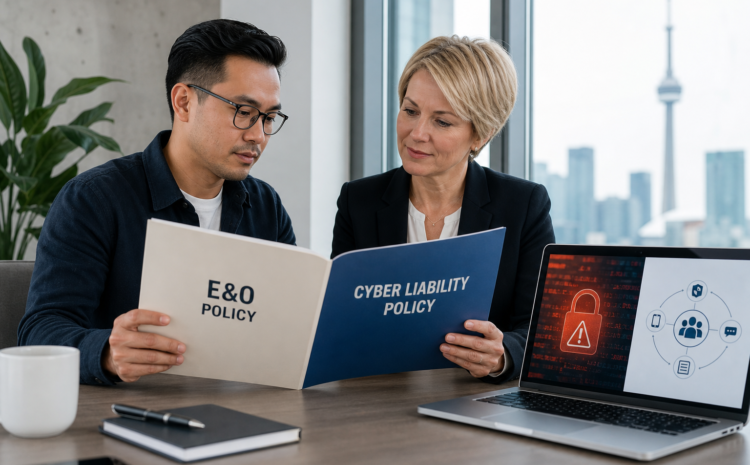
E&O vs Cyber Liability: Which Coverage Fits Your Business?
E&O and cyber liability insurance respond to different starting risks. E&O, or errors and omissions coverage, generally addresses allegations that professional advice, services, or deliverables caused a client financial harm. Cyber liability generally addresses a cyberattack, data breach, ransomware event, or other security failure affecting systems or information. Actual policy wording, exclusions, limits, deductibles, and endorsements determine whether a particular claim is covered. This comparison of cyber and E&O coverage explains the distinction between the two triggers.
E&O vs cyber liability at a glance
The most useful comparison asks what happened first, whose financial interests were affected, and what the business was expected to provide. This table is a starting point, not a coverage determination. For broader context, see these Ontario business insurance coverage options.
| Criterion | E&O | Cyber liability |
|---|---|---|
| Typical trigger | An alleged error, omission, professional mistake, or failed service or deliverable. | A cyberattack, data breach, ransomware event, unauthorised access, or other security incident. |
| Primary concern | The quality, accuracy, or performance of professional work. | The security, availability, or confidentiality of systems and information. |
| Potential loss | A client or other party alleges that the business’s work caused financial harm. | The business faces incident-related costs, claims from affected parties, or both, depending on the policy. |
| Example | A software implementation contains a defect or professional advice leads to a client loss. | Ransomware prevents system access or an unauthorised party obtains confidential information. |
| Key question | Could a client allege that our professional work was inaccurate, incomplete, late, or ineffective? | Could a security or data event create response costs, disruption, or claims by affected parties? |
What E&O is designed to address

E&O is commonly understood as professional liability coverage. Its central question is whether professional work led to a client’s financial loss. An allegation might involve incorrect advice, a missed requirement, an omission in a deliverable, or a service that did not perform as promised. The relevant trigger is the alleged failure in the work, rather than a cyberattack itself. E&O coverage is commonly distinguished from cyber coverage by this professional-services trigger.
For technology companies, technology E&O may be more relevant than a generic professional liability description. A business may provide software, platforms, implementation services, hosting, IT advice, or other technology deliverables. A software bug, service outage, or failed implementation can create a client claim because the product or service did not perform as expected. Technology E&O examples include software and service failures that cause client financial harm.
Do not assume that every standard professional liability policy addresses every technology exposure. Software failures, data-handling errors, and security tools that fail to perform may require careful review of definitions and exclusions. Technology-specific exposures can fall outside a policy not written for the business’s actual services. Chase also provides broader business insurance liability information for Ontario companies.
What cyber liability is designed to address
Cyber liability generally starts with an event involving a business’s systems, network, or data. Examples include ransomware, unauthorised access, business email compromise, or accidental disclosure of personal or confidential information. The event may affect the business directly, create an obligation to respond, or lead to claims by affected people or organisations. Cyber liability is generally associated with cyber and data-security events rather than an ordinary professional-service error.
Cyber exposure is not limited to technology companies. A small business may store customer information, rely on cloud platforms, process online payments, communicate by email, or depend on connected systems. The relevant question is how the business uses systems and information, not simply its industry classification. Chase’s small business insurance resource provides broader commercial coverage context.
Cyber liability is not a guarantee that every loss following a computer problem will be covered. The policy may distinguish between a security event, ordinary technology breakdown, employee error, service interruption, and a claim alleging that a product failed. Those distinctions must be checked against the wording of the policy being considered.
Four scenarios that show the difference
Real situations can involve more than one issue. These examples identify the first coverage question without treating the result as automatic.
1. A faulty software implementation
A technology provider implements software for a client, but a configuration or coding error causes incorrect results. The starting allegation is that professional work or a technology deliverable failed. That points first to an E&O or technology E&O question: what service was promised, what went wrong, and what financial loss is alleged?
2. A ransomware event
An attacker encrypts the business’s systems and demands payment. The starting event is a cyberattack affecting systems. Relevant cyber liability questions may include available response services, the business’s losses, and whether affected third parties can make claims. The answer depends on the policy’s coverage sections and conditions.
3. Information sent to the wrong recipient
An employee accidentally emails personal or confidential information to an unintended recipient. There may be no professional advice error or software defect, but there is a data-security and confidentiality event. The business should examine whether its cyber policy addresses accidental disclosure, response obligations, and claims by affected parties.
4. A cyber incident also causes client losses
An attacker enters a technology provider’s platform, interrupts the service, and causes customers to lose access or suffer financial harm. The starting event is cyber-related, but customers may also allege that the provider failed to deliver its service. This is where cyber liability and technology E&O can overlap. A security incident affecting a technology service can raise both network-security and service-performance questions.
Where E&O and cyber liability can overlap
The overlap is easiest to understand as a sequence: a security failure happens, the business’s service is disrupted or performs improperly, and a client claims financial loss. Cyber liability may be relevant because the initiating event involved systems or data. E&O may be relevant because the client alleges that the service failed. Some insurers offer combined technology E&O and cyber policies because technology businesses can face both exposures.
Overlap does not mean both policies will automatically respond, that one insurer will accept the claim without question, or that buying both eliminates every gap. Policies may contain different definitions, exclusions, sublimits, deductibles, and rules for related events. The task is to identify how the business operates and test that exposure against the wording of each proposed policy.
Which businesses should examine each coverage?
- Professional advisers and service firms: examine E&O if clients rely on advice, analysis, designs, recommendations, reports, or other deliverables that could allegedly cause financial harm.
- Technology providers: examine technology E&O if the business develops software, provides implementation or IT services, hosts platforms, or promises a technology product or service.
- Businesses handling personal or confidential information: examine cyber liability if a breach, unauthorised access, accidental disclosure, or other security event could affect customers, employees, vendors, or the business.
- Businesses dependent on cloud systems or online transactions: examine cyber exposure if disruption, credential compromise, or a security incident could interrupt operations.
- Businesses with both service and security risks: examine both coverage types, particularly when clients depend on the availability, accuracy, or security of the business’s technology.
For broader commercial context, review Chase’s business insurance liability information. Describe the actual services, contracts, systems, and data practices when requesting coverage advice.
Questions to prepare before comparing policies
- What do clients receive? List advice, software, reports, designs, implementation work, hosting, support, managed services, and other deliverables.
- What does each contract promise? Note service levels, performance commitments, liability provisions, indemnities, privacy obligations, and insurance requirements.
- What information does the business handle? Identify personal, financial, health, payment, employee, customer, or confidential commercial information.
- Which systems and vendors are essential? Include cloud providers, payment processors, email systems, outsourced IT, and data-storage providers.
- What could interrupt the service? Consider a software defect, unavailable platform, compromised account, ransomware, lost device, or employee error.
- What response would be needed? Consider investigation, legal advice, notification, restoration, communication, and customer support.
- What wording needs close attention? Ask about technology-specific exclusions, data-related exclusions, service-failure provisions, limits, deductibles, endorsements, and reporting requirements.
Bring current policy documents, contracts, a description of services, revenue information, and an outline of data-handling practices. You can also review business insurance options in Ontario before requesting a tailored comparison.
Why policy wording matters more than the label
“E&O” and “cyber liability” are useful starting labels, but they do not answer every claim question. Review:
- Definitions: how the policy defines professional services, technology products, security events, data, systems, and covered loss.
- Exclusions: provisions affecting software performance, contractual liability, technology failure, employee error, prior knowledge, or data-related events.
- Financial structure: limits, sublimits, deductibles, waiting periods, and conditions for particular coverage sections.
- Claims requirements: when and how an incident or circumstance must be reported, and what the business must do after discovering a potential claim.
A standard professional liability policy may not clearly address every technology-specific exposure, while a cyber policy may not replace professional liability for faulty advice or a failed deliverable. The distinction should be tested against the actual policy wording.
E&O vs cyber liability questions
Can E&O insurance replace cyber liability insurance?
It should not be assumed to do so. E&O generally addresses allegations about professional work, while cyber liability generally addresses cyber and data-security events. Review the definitions and exclusions of the actual policies.
Should a technology business consider both E&O and cyber liability?
A technology business should examine both exposures when it provides a product or service clients rely on and also stores data, operates connected systems, or could face a security event. Some insurers offer combined technology E&O and cyber solutions, but the appropriate structure depends on the business and policy wording. Technology businesses can face connected E&O and cyber questions when a service failure involves a data breach.
Does a standard professional liability policy automatically cover technology-related failures?
No automatic assumption is safe. The answer depends on how the policy defines professional services, technology products, software, data, security events, and covered loss. Ask specifically about the technology the business develops, sells, manages, or relies on.
Choose coverage based on how your business can suffer a loss
The clearest distinction in the E&O vs cyber liability comparison is the starting risk. E&O generally begins with an allegation that professional work or a technology deliverable caused client financial loss. Cyber liability generally begins with a security or data event affecting systems or information. Technology and professional service businesses may face both.
Map your services, client promises, data, systems, vendors, and likely incident scenarios. Then compare definitions, exclusions, limits, deductibles, endorsements, and claims requirements instead of relying on the policy label. Chase Insurance Brokers Ltd. is an Ontario-based brokerage offering business insurance and quote or meeting options. Request a business insurance discussion with Chase Insurance Brokers after gathering your current policy documents and business details.