

Compare Ontario Business Insurance Coverage Options
Compare Ontario Business Insurance Coverage Options
Business insurance is not one product that automatically responds to every loss. A storefront, consultant, contractor and online retailer may all need “business insurance,” but the event each one needs to finance can be entirely different. Comparing options by product name alone hides that difference.
This article is general education, not legal, insurance, financial or risk-management advice. It does not quote a premium, recommend a limit or confirm that any insurer will offer, bind or pay a claim. Review the actual policy and obtain advice for your operations.

Start with the loss event, not the policy label
Write down what the business owns, does, transports, stores and promises. Then describe what could go wrong. The Insurance Bureau of Canada’s business coverage overview distinguishes common commercial options including property, commercial general liability, business interruption, professional liability, commercial auto and cyber insurance. It also emphasizes deductibles, limits and ongoing review with an insurance representative.
An exposure inventory can begin with six questions:
- Could a customer, visitor or other third party allege bodily injury or property damage?
- What buildings, stock, equipment, tools, electronics or tenant improvements would be expensive to repair or replace?
- How would revenue and continuing expenses be affected after physical damage closes or restricts operations?
- Could an error in advice, design or professional service cause a client financial loss?
- Does the business collect personal information, depend on networks or face cyber extortion and restoration costs?
- Are owned, leased, hired or employee vehicles used for business?
Contracts, leases, lenders and clients may impose separate insurance requirements. A certificate of insurance can show evidence of coverage but does not expand the policy. Have a qualified professional review contractual obligations where the stakes are material.
Compare common coverage options side by side
| Coverage family | Event that starts the discussion | Who may need to examine it | What not to assume |
|---|---|---|---|
| Commercial general liability | A third party alleges bodily injury or property damage connected to operations, premises, products or completed work | Businesses interacting with customers, the public, job sites or third-party property | It does not automatically replace professional, auto, cyber, pollution or every product exposure |
| Commercial property | Business property is physically lost or damaged by an insured peril | Owners or tenants with buildings, contents, equipment, stock or improvements | “All risk” does not mean every cause; exclusions, conditions and valuations still apply |
| Business interruption | Operations are suspended following a loss that meets the policy trigger | Businesses that would lose income or incur extra expense after covered damage | Any shutdown, utility failure, cyber event or supplier problem will be covered automatically |
| Professional liability or E&O | A client alleges an error, omission or negligent professional service caused loss | Consultants, designers, technology providers and other advice or service businesses | CGL automatically covers purely financial loss arising from professional advice |
| Cyber and privacy | A specified data, privacy, network, extortion or security event occurs | Businesses using systems, online operations or personal and confidential information | Every cyber event, fine, ransom or pre-existing weakness is covered |
| Commercial auto | A vehicle used for business is involved in a loss | Businesses owning or using vehicles, or relying on hired and non-owned vehicles | A personal auto policy automatically covers every business use |
These categories are a comparison framework, not policy summaries. Definitions, triggers and exclusions vary. The IBC notes, for example, that business interruption is commonly an optional addition to commercial property and may involve a physical-damage requirement. A cyber incident may need its own coverage rather than being treated as ordinary property damage.
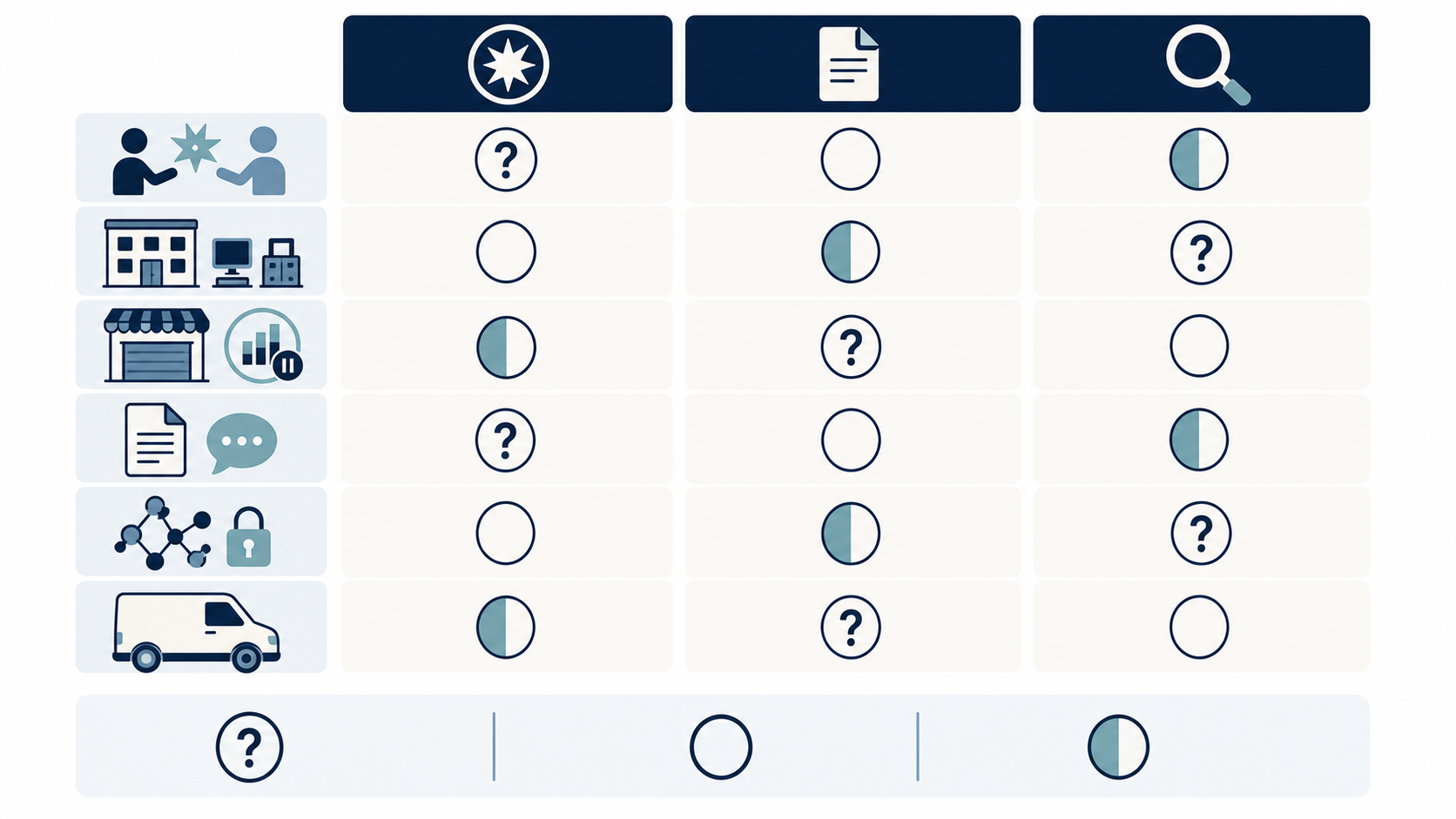
Match coverage discussions to real operating scenarios
A customer slips at a retail location
This raises a third-party bodily-injury liability question. Discuss premises and operations coverage, limits, deductibles, defence costs and exclusions. Do not assume a claim is covered or that the business is legally liable; those are separate determinations.
A fire damages stock and closes the premises
Property and business-interruption questions may both be relevant. Compare how property is valued, what perils and property are included, the interruption trigger, waiting periods, indemnity period, payroll treatment and extra expense. The fact that a business is closed does not by itself establish coverage.
A client alleges bad professional advice
Professional liability or errors-and-omissions coverage may be the closer category. Ask about covered services, retroactive dates, claims-made reporting requirements, exclusions and how subcontracted work is treated.
A business suffers a privacy breach
Cyber coverage may address specified first-party response expenses and third-party liability, depending on wording. The Office of the Privacy Commissioner of Canada states that organizations subject to PIPEDA have breach-reporting, notification and record-keeping obligations in defined circumstances. Insurance does not replace the organization’s legal response plan or privacy obligations.
An employee uses a vehicle for a delivery
Owned, hired and non-owned vehicle exposures should be described accurately. Ask which policy responds, whether the use is acceptable and what records or driver controls the insurer requires.
Compare business insurance quotes on the same basis
A lower total premium can reflect narrower coverage, different deductibles, a different valuation method, a smaller limit or omitted optional protection. RIBO’s consumer information warns that unusually low estimates can be a reason to ask questions and says commercial and liability policy wordings can have different conditions and exclusions.
| Comparison field | What to record for each quote |
|---|---|
| Named insured and operations | Legal entities, locations, revenue, activities and territories the insurer evaluated |
| Coverage forms | Exact form names, occurrence or claims-made basis, and key definitions |
| Limits and sublimits | Per occurrence, aggregate and special sublimits that may restrict a category of loss |
| Deductibles and waiting periods | What the business pays or absorbs before coverage responds |
| Exclusions | Important activities, property, causes of loss, territories or professions that are excluded |
| Endorsements | Changes that add, remove or amend standard wording |
| Insurer requirements | Risk controls, maintenance, cyber safeguards, alarms, contracts or reporting obligations |
| Premium and payment | Final confirmed premium, taxes, fees, financing charges and cancellation terms |
Ask for material differences in writing. A quote is not the same as bound coverage, and a broker is not the insurer that underwrites the risk or decides a claim. Coverage begins only when the authorized parties confirm it in accordance with the applicable terms.
Prepare a clean business information package
Incomplete or inconsistent information can make comparisons unreliable. Before requesting quotes, gather:
- legal name, operating names, ownership and years in business;
- detailed operations, products, services and percentage of revenue by activity;
- annual revenue, payroll, number of employees and subcontractor use;
- locations, occupancy, construction, protection systems and lease responsibilities;
- replacement values for stock, equipment, tools, improvements and buildings where applicable;
- contracts, certificates and required limits;
- vehicle lists, drivers and business use;
- technology systems, types of data, security controls and incident response plan;
- prior insurance, cancellations and claims or loss history; and
- material changes planned during the policy period.
Disclose operations accurately, even when a detail seems likely to increase premium. RIBO tells consumers to provide a detailed explanation of their circumstances and to update the broker and insurer about material changes. Misrepresentation or non-disclosure can affect coverage and future insurability.
Red flags and mistakes to avoid
- Buying only a label: “business package” does not explain its triggers or exclusions.
- Comparing only total premium: different terms can make prices non-equivalent.
- Assuming all risks are covered: every policy has definitions, conditions and exclusions.
- Ignoring contract requirements: a client or landlord may require specific wording or status.
- Understating operations: omitted activities can distort underwriting and coverage analysis.
- Confusing a certificate with the policy: evidence of insurance is not an amendment to wording.
- Leaving cyber outside the review: privacy and network events do not necessarily fit property or CGL forms.
- Failing to review changes: new services, locations, revenue, equipment or vehicles may be material.
- Treating a broker as the insurer: the insurer controls underwriting and claims decisions under the policy.
Questions to ask before choosing an option
- Which exposure in my business does each proposed coverage address?
- What event must occur before the policy can respond?
- Which activities, property, people, territories or causes of loss are excluded?
- Which limits, sublimits, deductibles, waiting periods and co-insurance conditions apply?
- Are any coverages claims-made, and what retroactive date and reporting rules apply?
- What risk controls or information must I maintain?
- Which available markets were approached, and how does the broker receive compensation?
- What must I report if my operations change?
- What remains uninsured or should be addressed through contracts, reserves or risk controls?
Frequently asked questions
Is business insurance mandatory in Ontario?
Some insurance can be required by law, while other coverage may be required by a lease, lender, client or professional arrangement. Requirements depend on operations and contracts. Obtain advice rather than relying on a general article.
Does commercial general liability cover professional mistakes?
Do not assume so. Professional liability or E&O is designed for certain allegations arising from professional services or advice, subject to its own wording, while CGL has a different trigger and exclusions.
Is business interruption included with property insurance?
IBC describes business interruption as an optional addition to commercial property. The trigger, covered income, waiting period and indemnity period depend on the actual form.
Will a broker guarantee the lowest premium or claim payment?
No such guarantee should be inferred. Insurers set underwriting terms and premiums and decide claims under policy wording. Compare coverage and total terms, not an unsupported outcome promise.
Build one exposure matrix before requesting quotes
List the events that could hurt the business, connect each event to a coverage question and then compare proposals on the same fields. That produces a more meaningful conversation than asking which single policy is “best.”
Sources reviewed
- Chase Insurance Brokers business insurance and quote request — first-party service categories and inquiry route only; no marketing outcome is endorsed.
- Insurance Bureau of Canada types of business coverage — Canadian industry overview of common commercial coverage categories and comparison factors.
- RIBO consumer rights and expectations — Ontario regulator guidance on quotes, disclosures, wordings, licensing and consumer obligations.
- Office of the Privacy Commissioner of Canada breach reporting — official privacy-breach obligations for organizations subject to PIPEDA.